The Phoenix Suns team would have accepted in a heartbeat if they had been informed prior to the start of the 2025–26 season that they would be in the 2026 NBA playoffs after winning a total of 45 games during the regular season. The Suns were supposed to be in a transitional phase this year after trading Kevin Durant and purchasing Bradley Beal’s contract. The team had different plans, though, and all things considered, the season was a success.
The Oklahoma City Thunder, the current champions, did, indeed, win the first round in a sweep. However, under the leadership of head coach Jordan Ott, the Suns are developing a long-term strategy in the Valley that focuses on pace, spacing, and disruptive defense, which seems like it has the potential to lead to anything in the future.
The Suns’ immediate future, though, is not particularly bright. The Washington Wizards still owe their first-round selections in 2027 and 2029 to the Houston Rockets, have swap rights over their 2030 first-round choice, and the Utah Jazz completely own their pick in 2031.
The Suns are at least prepared to continue winning games for the next several seasons, and suffice it to say that they must do so. However, does the front office have sufficient faith in their prospects to be aggressive in the trade market in order to maintain pace with the other competing teams in the West?
Following the Suns’ first-round loss to the Thunder, here is a quick analysis of their roster and which players they should and should not trade.
The Suns need to safeguard their core.
protected from trade: Devin Booker, Dillon Brooks, Collin Gillespie, Khaman Maluach, Oso Ighodaro, Ryan Dunn, Rasheer Fleming
After the Suns’ upbeat 2025–26 season, it will be difficult to convince the team’s fan base to give up on the core.
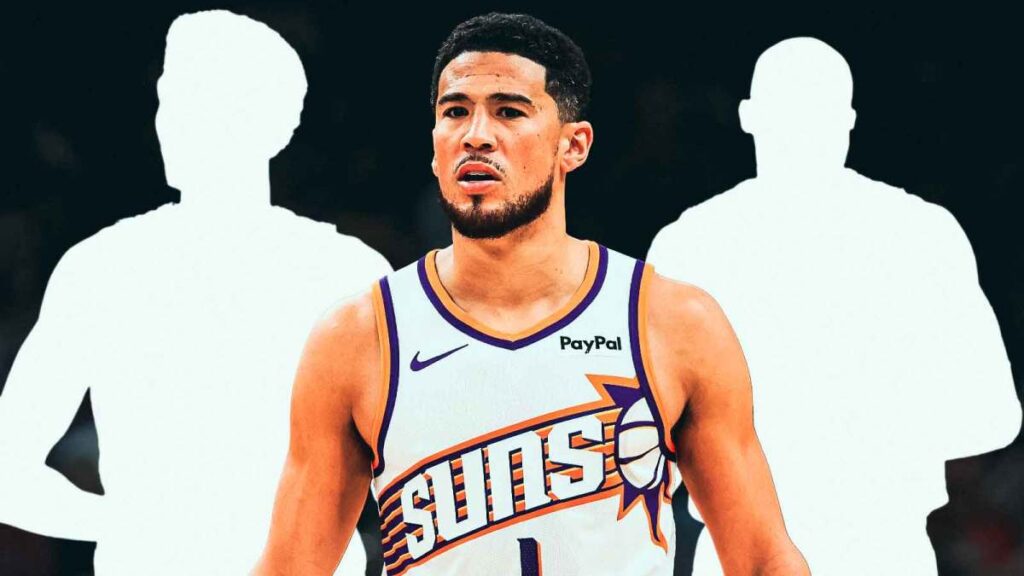
Teams that were unsuccessful in this year’s playoffs, such as the Detroit Pistons, will undoubtedly mention Devin Booker’s name in phony trades. The Pistons require what Booker offers, which is additional offensive production, as well as an already well-known primary ball handler.
Booker would be an excellent complement to Cade Cunningham because he can both absorb some ballhandling reps and offer a supplementary scoring threat. With Booker’s help, Cunningham would be able to bear the weight of the playoffs.
But the Suns have no cause to simply give away the face of their organization. Phoenix will still owe a few of their future firsts, and Booker has at least three more years left on his contract. As a result, they will need the floor of production that Booker provides to ensure that they at least remain semi-competitive for the next few years.
Dillon Brooks, meanwhile, has made himself an indispensable member of this Suns squad. Everywhere he goes, he establishes himself as a cultural leader, and Suns owner Mat Ishbia has stated that they will not trade Brooks under any circumstances. Additionally, one may assume that anything the team’s leadership says is law.
There is no cause for the other Suns players to give up on any of their young talent.
The Suns had good reason to be thrilled with Khaman Maluach, who was selected tenth overall in the 2025 NBA Draft. He’ll only be 20 years old when the next season starts, and maybe he can establish himself as the team’s long-term solution at center right away when the 2026–27 season gets underway.
With a combined $7. 2 million for three rotation players, Rasheer Fleming, Ryan Dunn, and Oso Ighodaro will earn a small sum next season.
After attempting 7. 2 shots per game from beyond the arc and making over 40% of them, Collin Gillespie will be a free agent, but he is definitely worth keeping because he averaged 13/4/5 the following season. In addition, he is the sole true point guard on the roster and a genuine success story for the Suns’ development squad.
Phoenix needs to at least consider offering these mid-sized contracts.
The Suns should merely exercise due diligence by gauging interest in some of their players who will be earning nine figures the following year. The Suns’ need to trade these athletes is not something that is supported by this.
In spite of Gillespie’s emergence as a quality player, Phoenix must continue to consider finding someone who would be a better long-term complement to Booker in the backcourt; Jalen Green will be earning $36. 2 million the following season. While Booker may be the main ball handler on a winning club, he played his best when paired with a more organic playmaker, and Green may have a similar playing style.
Despite this, Green’s play for the Suns improved significantly toward the end of the season, and he is just 24 years old.
Every winning team would want Royce O’Neale and Grayson Allen on their roster. O’Neale is the ideal three-and-D wing player that complements any lineup, and Allen provides ballhandling and shooting when needed. The Suns may at least consider trading them in a consolidation-type transaction if it would result in an upgrade, as both have two years remaining on their contract.
Although Jordan Goodwin is an upcoming free agent, he played a key role for the Suns this past season. He is a viable contender for a multi-year deal, and at some point, he may even become a salary-matching trade asset for Phoenix.
Does the future revolve around Mark Williams?
Potential trade: Mark Williams
The Suns acquired Mark Williams during the 2025 draft, and the reasoning behind this move was apparent. Williams consistently achieves double-doubles and performs as a reliable starting center, offering stability as Maluach matures.
However, Williams’ current contract is nearing its expiration. Naturally, the Suns will likely keep him, at least to protect their investment. But it would not be surprising if the 24-year-old becomes a regular topic in trade discussions, especially since he continues to pose an injury concern and the team already has a successor prepared to step into his position.