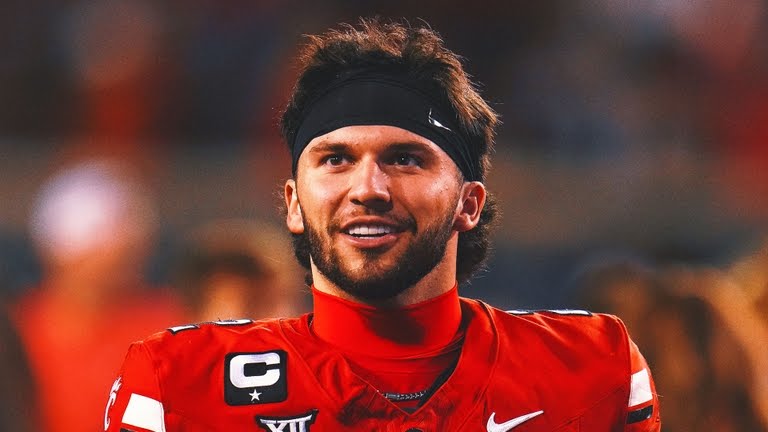
Texas Tech quarterback Brendan Sorsby, who sought inpatient therapy for a gambling issue three weeks ago, filed a lawsuit Monday asking the NCAA to reinstate his eligibility.
Sorsby had struck a multimillion-dollar agreement to return to his home state for his final college season, but his eligibility was jeopardized when he confessed to gambling on sports.
His lawsuit, filed in Lubbock County, Texas, by local attorney Dustin Burrows, seeks an injunction allowing him to teach and play for the Red Raiders. According to the filing, legal action was taken because the NCAA completely disregarded its responsibilities and duties to safeguard Sorsby’s well-being.
His gambling addiction, according to the complaint, is a medically diagnosed illness that the American Psychiatric Association identifies as a mental illness in its Diagnostic and Statistical Manual of Mental Disorders.
According to the complaint, the NCAA has exploited his position to create a façade of competitive integrity while profiting from the same gambling industry it regulates. It claims that Sorsby accepted responsibility for breaching NCAA regulations and offered to face appropriate punishment, but not a complete loss of eligibility.
Texas Tech said on Monday that after settling on an agreed-upon set of facts between the university, the NCAA, and Sorsby, it has declared Sorsby ineligible.
Texas Tech hopes to begin the restoration procedure immediately, according to the institution. Texas Tech’s major priority remains supporting Sorsby’s health and well-being.
As of late Monday afternoon, the NCAA said it had not received a reinstatement request for the Sorsby incident.
The NCAA does not usually comment on pending reinstatement requests, however the Association’s sports betting rules are explicit, as are the reinstatement requirements, according to a statement. These regulations must be applied in all cases when betting on one’s own team since the game’s integrity is at issue. Every athletic association has these safeguards in place, and the NCAA will continue to use them consistently to ensure that every student-athlete competing is aware that they are participating in a fair game.
Sorsby began his collegiate career at Indiana in 2022 before transferring to Cincinnati for the past two seasons. ESPN previously reported, citing unknown sources, that Sorsby placed thousands of online wagers on a range of sports using a betting app.
NCAA regulations were relaxed in 2023 to account for the rise of regulated gambling, but they nevertheless mandate a lifetime ban for athletes who gamble on their own games.
According to ESPN, Sorsby wagered on Indiana football games in 2022 and only won. He did not gamble on the single game in which he participated as a rookie that season.
Sorsby’s complaint described the NCAA’s position on gambling as hypocritical because it has a deal with Genius Sports to provide real-time data feeds to sportsbooks, publicly promoted gambling as a huge opportunity, and oversaw an enterprise in which $3. 3 billion was bet on its basketball tournaments in 2026.
Jeffrey Kessler, the players’ main counsel in the historic House settlement that expedited the professionalization of collegiate athletics, leads Sorsby’s legal team.