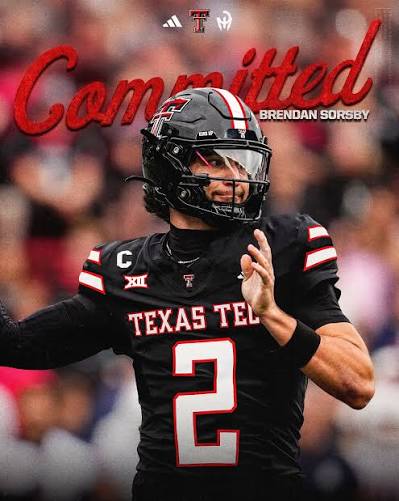
Brendan Sorsby committed to Texas Tech in January as the top quarterback in the NCAA transfer portal (a database that facilitates college sports’ equivalent of free agency). Last season, the Texas Tech Red Raiders won their first Big 12 title in program history, and Sorsby was named the one to lead the team to the promised land of a national championship the following season. According to reports, he was going to earn roughly $5 million just for showing up, and he had the opportunity to be the face of college football in 2026.
However, before his first snap, he became the new face of sports gambling instead.
Texas Tech stated on April 27 that Sorsby had voluntarily checked himself into a residential treatment facility for a gambling problem. According to ESPN’s Pete Thamel, Sorsby’s decision “came after the discovery of Sorsby placing thousands of online bets on a range of sports using a gambling app. ” It all started with wagering on the Indiana Hoosiers to win games he did not participate in as a redshirt genuine rookie on the squad. He is not thought to have attempted to affect game results; his strategy was described to Thamel as “a consistent stream of modest wagers over time. “
Sorsby is currently under NCAA investigation since the organization prohibits athletes from wagering on both college and professional events. According to ESPN’s Adam Schefter, he has hired Jeffrey Kessler as his lawyer to fight to regain his college eligibility, and he can apply for the NFL’s supplemental draft if it is found that he is prohibited from college football.
Even if he is not prohibited, the “sports gambling addiction” designation will follow Sorsby in football circles, at least in the near term. The NFL has a history of being extremely harsh on gambling.
The most well-known example occurred in March 2022, when the NFL suspended star wide receiver Calvin Ridley, then with the Atlanta Falcons, for one full year after he wagered for five days in November 2021 while away from the Falcons to “focus on my mental well-being. ” Following the NFL’s restoration of him in March 2023, Ridley detailed his experience in The Players’ Tribune. He said in part, “I was still so sad and furious, and the days were so long. I was seeking for something to distract me and make the day go quicker. One day, I saw a television advertisement for a betting app and downloaded it on my phone. I deposited around $1,500 in all, purely for something to do. ”
Sorsby is 22 years old. It would be a travesty for him to go from hot NFL prospect to outcast, especially since his innocuous activities harmed nobody. He didn’t cheat games, and the NFL pardons much worse all the time. It remains to be seen if the NFL would punish Falcons linebacker James Pearce Jr. , who just signed a six-month intervention program in an attempt to have three felony allegations dropped. (Not to mention the crimes of the most powerful people in our nation, who commit far more serious offenses on a daily basis and get away with it. )
It’s also a pity since Brendan Sorsby isn’t the true face of sports gambling.
America is.
Turn on any sports broadcast and you’ll be greeted with a barrage of live odds and gambling adverts, if not an outright sponsorship by DraftKings or FanDuel.
CBS Sports published a story about Sorsby’s gambling problem and couldn’t help but devote a section to Texas Tech’s revised Big 12 title chances on FanDuel.
According to Front Office Sports, several famous athletes are active investors in the controversial and rapidly growing prediction-market business Kalshi, and the Trump administration is actively suing three states in a garish attempt to override state gambling legislation and keep the prediction-market industry thriving.
According to the American Gaming Association, the sports betting industry generated a record $16. 96 billion in revenue last year, with $166. 94 billion spent on legal American sports bets.
This Pew Research Center study conducted last October highlights the widespread cognitive dissonance that has enabled gambling to permeate sports and daily life across the country. It’s a billion-dollar business that many people feel terrible about engaging in but can’t quit, akin to doom-scrolling or any other common addiction. As of last summer, 43% of American adults think sports betting is harmful to society, while 40% feel it is bad for sports. Only 7% and 17% thought it was beneficial for society and sports, respectively.
Sorsby has not spoken publicly about the origins or essence of his sports betting compulsion, thus it would be wrong to speculate on the details of his narrative. However, three universal truths apply. Addiction has never cared about how much someone has to lose; it only cares about taking as much as possible. Addiction never occurs in a vacuum, and the storylines of this very American tale hold true regardless of who plays the key role.
Would it ever occur to you that you were jeopardizing your future with each tap of your finger if you grew up in a society where gambling apps lived in your pocket and placing a sports wager was as natural as brushing your teeth?
How can you know you have an addiction when you’re innocently imitating completely normal behavior around you?
Perhaps none of this persuades you. Perhaps you do not see Sorsby as a sympathetic character since he is a star quarterback. Football is king, and quarterbacks are the crowned princes who are always expected to be the exception to the rule. He should have realized that he couldn’t be just one of the lads making bets in the group chat; he had NCAA eligibility and a promising NFL career to safeguard.
Heavy is the head that wears the crown, or something like that. However,behind that helmet is a person, and no helmet orpadding has ever guarded against human error.
Sorsby has been the exception to the norm on the football field his whole life, defying human physical limits to throw further, run quicker, and win more than otherpeople. He is now an even more significantoutlier off the field for seeking help for the vice that quietly controlspeople around him in plain sight.