Edmonton Oilers coach Kris Knoblauch does not preach on his great hockey ideas, nor does he give lengthy public lectures on hockey technique. However, if you listen attentively, you will grasp the overall subject of what he has come to believe will make a difference for the Oilers in the 2026 playoffs.
Knoblauch’s views on success are articulated, but they are simple to overlook if you are not careful. He delivers them gradually, rather than in a passionate speech or a list of bullet points.
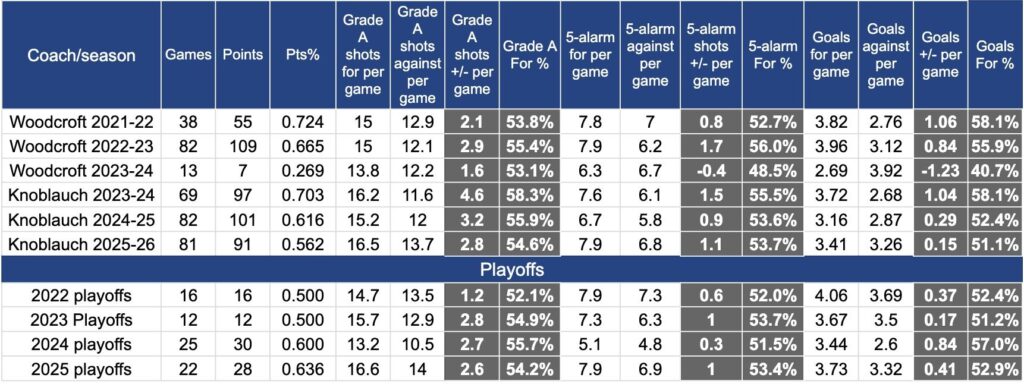
This year, as his team has struggled like never before to find its game for him — owing, in large part, to the constant intake of new players and the mental and physical stress of two lengthy playoff runs — he has focused on two themes: the need for the Oilers to play a high-skill puck possession game, and the need for this team with so many great attacking superstars to play with patience, to not always push so hard on dangerous attacking plays but to control the game through possession, and to rely on the other guys to grow impatient, to make the mistakes, and then to use Edmonton’s high-end talent to punish them for those mistakes.
It’s a wonderful strategy, but getting a group of high-spirited, aggressive thoroughbred horses to cooperate to pull the Oilers cart isn’t always easy. They want to score, score, and score. They are not always willing to sit back and watch for the other person to make a mistake, providing them with an opportunity. They want to compel a breakthrough.
However, as Knoblauch has noted, trying things might result in turnovers and costly errors, no matter how good a player you are.
The Oilers coach emphasized his patience theme in passing once again this Tuesday, when Sportsnet’s Mark Spector asked him about the secrets to playoff success.
Knoblauch answered, “It’s the little things that are going to make the difference, the little things, you know, getting a stick on a puck, getting a block, getting a puck in deep. And it’s monotonous work, but it’s really vital for our guys to do it together again and over again. And by doing so, you give yourself the opportunity to win. And, ideally, you do it long enough for the other team to get impatient (emphasis mine). “They break down, and then you take advantage of it. “
Edmonton lacks the tremendous talent to smash rival clubs, particularly strong ones, in this salary-capped NHL, where good and rich teams are often unable to hoard top players by flinging around money. However, Knoblauch’s reasoning appears to be that if the Oilers make roughly the same number of errors as the other team, or perhaps fewer, Edmonton will win because the Oilers have greater star, mistake-punishing potential than the other team.
It’s a solid strategy, at least if you can persuade Edmonton’s best players not to push too hard on the attack and to instead cycle, maintain, and manage the puck when there isn’t a clear path to the net, particularly when Edmonton has a lead or the game is tied.
This year, Edmonton has been punished multiple times for attempting to score more goals too quickly, but Knoblauch’s message appears to have sunk in since Leon Draisaitl was injured, and the possibility of outscoring their own errors must have appeared less likely to every Oilers player.
Knoblauch was the most explicit about this topic after Edmonton’s first triumph in a recent five-game winning run, when he was questioned what his team had done so well in that first win, a dominating performance against Utah.
“Well, simplicity,” Knoblauch responded. “And not feeling like we have to score off the rush. And you know, if there’s a chance to score off the rush, it’s an odd man chance, so we want to take it. But if they have troops back, it’s quite difficult to create offensive possibilities. It simply does not matter how excellent you are or how lovely of a pass you make; it typically results in turnovers and a lack of time in the offensive zone. And I believe we’re extremely motivated to make things difficult for their defence, and we’ve created a pretty good forecheck. ”